Sports leagues that once warned prediction markets posed integrity risks are striking a different tone as the regulatory picture shifts.
It comes as the Commodity Futures Trading Commission signals it is prepared to defend sports event contracts as federally regulated derivatives, a stark departure from its previous hands-off approach.
The shift mirrors the industry’s posture toward sports betting a decade ago, when fierce opposition gave way to commercial embrace once legalization and the revenue tied to it became inevitable.
NBA signals a softer approach
That shift was visible during NBA All-Star Weekend, as executives from Kalshi and Polymarket appeared on a panel at the league’s Tech Summit, an invite-only gathering that included league partners and sportsbook executives.
Commissioner Adam Silver, speaking during the weekend, acknowledged the exchanges’ rapid rise and their growing proximity to the league’s betting ecosystem.
“Obviously, it’s an issue that I’m paying [an] enormous amount of attention to,” Silver said. “It’s rapidly evolving. Prediction markets have now come on the scene fairly recently as, I don’t know how else to say it, major sports betting marketplaces.”
The league has not struck a formal partnership with prediction market platforms. But its willingness to host executives, platform operators, and sportsbook stakeholders in the same forum reflects a markedly different posture than it held just months ago.
In a letter to federal regulators last year, NBA counsel warned prediction markets posed integrity risks “more significant and more difficult to manage than those presented by legal, regulated sports gambling.”
Prediction markets viewed as betting
Silver also addressed Milwaukee Bucks forward Giannis Antetokounmpo’s recent ownership stake in prediction market platform Kalshi.
“We have a rule that was collectively bargained with the Players Association that players can make, I will call them, de minimis investments in sports betting companies, and we’re applying the same rule to prediction markets,” Silver said.
Kalshi said Antetokounmpo, who is participating in marketing campaigns tied to the partnership, is prohibited from trading on NBA-related markets. Critics, however have pointed to the optics of active contracts tied to his own career, including markets on which team he will play for next that have generated more than $23 million in trading volume since December.
CFTC rises to predictions’ defense
CFTC Chairman Michael Selig this week defended prediction markets in a Wall Street Journal op-ed and announced the agency will actively support them in a myriad of state lawsuits seeking to stop them.
He confirmed the agency filed an amicus brief supporting Crypto.com in federal appeals court and signaled the commission would no longer “sit idly by” while states attempt to block the products. Selig doubled down publicly, posting a video stating the agency would “fiercely defend” prediction markets’ legality. He emphasized prediction markets as tools that help everyday Americans hedge risk and evaluate information, citing weather and energy contracts and framing the exchanges as a check on the free press.
He made no mention of sports markets, which account for more than 86% Kalshi’s total trading volume over the past year. Weather and energy categories, by contrast, combine for roughly 2%.
The stance marks a sharp departure from Selig’s confirmation testimony just months earlier, when he declined to take a position on whether sports event contracts constituted gambling, saying he would “look to the courts” and that it would be “irresponsible” to prejudge the issue.
More than 30 states, tribal gaming groups, and the American Gaming Association have backed lawsuits alleging prediction markets constitute unlicensed sports betting, testing whether federal commodities law preempts state gambling statutes. Those lawsuits remain active, with many observers expecting the jurisdictional fight to ultimately reach the Supreme Court.
NFL observing ‘fan engagement’ tool
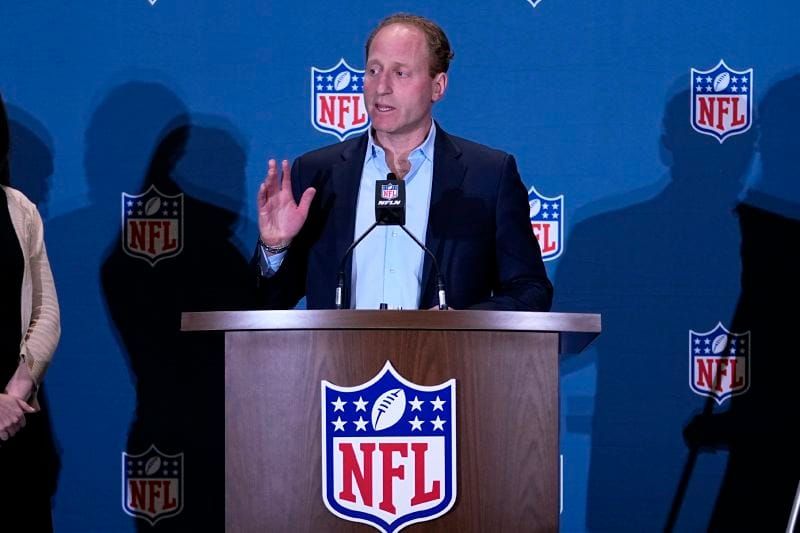
In an interview with Front Office Sports, NFL Executive VP of Communications Jeff Miller offered a more receptive view of prediction markets, while noting the regulatory landscape is still evolving.
“It’s innovative, that marketplace is dynamic,” Miller said. “… It is a fan engagement tool, there’s no question around that, and that’s been good for the league.”
That’s not quite the same tone Miller struck last year when he warned Congress about the risk of betting markets that don’t follow the same standards as the league’s sportsbook partners.
“We are particularly troubled that several sports-related futures contracts have been launched nationwide, including in jurisdictions where sports betting has not been legalized,” he told lawmakers at the time. “These contracts fall outside the purview of state regulatory authorities and the safeguards they impose upon the industry.”
MLB evaluates prediction markets
Speaking at owners meetings last week in Palm Beach, MLB Commissioner Rob Manfred said the league has already briefed clubs on the mechanics of event contracts and the potential role platforms could play in detecting suspicious betting activity.
“We thought it was important for the owners to be updated on why prediction markets are different than sports betting, why we might want to consider being in business with prediction markets in an effort to protect our integrity, to get the kind of protections we need,” Manfred said.
Last summer, MLB circulated a memo warning teams and players that the league’s existing gambling policies applied to prediction markets and that participation carried the same restrictions as traditional sports wagering.
“Any expansion of betting markets, particularly those outside of the established regulatory framework, raises serious questions about game integrity and oversight,” the league said in comments filed with the CFTC last year.
The NHL and MLS formalized partnerships last year with prediction markets, reflecting a more long-standing open posture than some of their larger counterparts. Meanwhile the Chicago Blackhawks and New York Rangers maintain their own club-level partnerships.
Leagues once fought sports betting
League engagement with prediction markets follows a posture shift the industry has navigated before.
Professional sports leagues were among the most vocal opponents of legalized wagering during the fight over the Professional and Amateur Sports Protection Act.
The NBA, NFL, MLB, NHL, and NCAA jointly sued New Jersey in after the state moved to legalize betting, arguing it threatened game integrity. As it became increasingly likely the Supreme Court would strike down PASPA, league posture began to shift.
In 2014, Silver famously authored a New York Times op-ed calling for federal legalization and regulation of sports betting, breaking from the league consensus that had backed the litigation.
After the ban fell in 2018, leagues formalized sportsbook partnerships, signed official data agreements, and integrated betting content across broadcasts and digital platforms. By the 2023–24 season, the NBA alone generated an estimated $160 million annually in gambling sponsorship revenue.