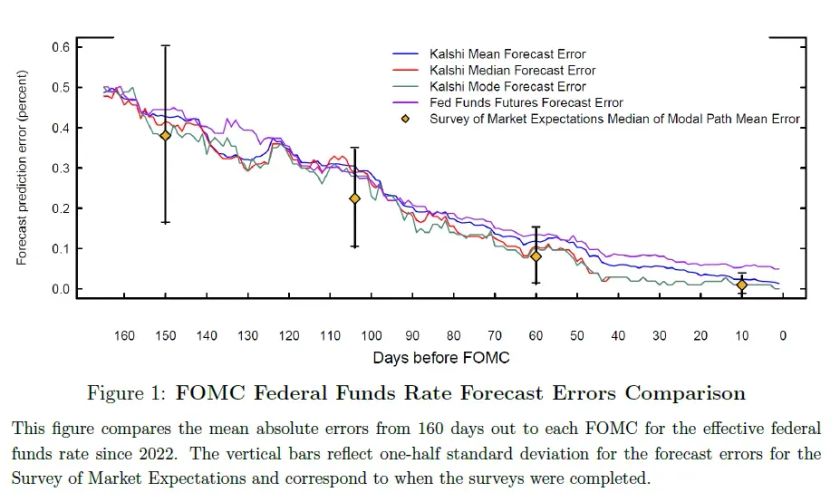
Kalshi, the booming platform that churns out predictions on everything from the Super Bowl to US elections, is showing early promise as an accurate forecaster of Federal Reserve policy and economic data, a new study finds.
When it comes to predicting interest-rate decisions, Kalshi is “roughly consistent” with professionals such as those surveyed by the Federal Reserve Bank of New York, according to a working paper authored by three economists, including one from the Fed. In a notable case, the prediction market even outperformed the pros when the central bank delivered a surprise, jumbo-sized cut.
The paper, which has not yet been peer reviewed, arrives ahead of Wednesday’s Fed decision. There’s little daylight between the forecasts for this event, with Kalshi and its rival platform Polymarket both showing a 99% chance that policymakers will hold rates steady, compared to 97.2% odds priced into fed funds futures. All 92 economist estimates compiled by Bloomberg predict the same outcome.
The findings on past Fed events and economic data releases could bolster the argument that prediction markets effectively harness the wisdom of the crowd to produce accurate forecasts that can inform risk-taking and policy decisions. Recently, the fast-growing platforms have been scrutinized over a dramatic increase in sports betting and what critics say are systemic vulnerabilities to manipulation and insider trading.
But at least to Wall Street, Kalshi may offer advantages over traditional forecasting, the authors say. Contracts are actively traded on the site, producing real-time updates on a broader set of variables while better reflecting the full range of potential outcomes.
“The real advantages are you’ve got a distribution instead of a point estimate, and you can look at how it responds very quickly after events,” said Jared Dean Katz, a Ph.D. student at the Northwestern University Kellogg School of Management who co-wrote the paper.
“It’s even better that the forecasts are pretty accurate,” he added.
Like its competitors, Kalshi offers trading on ‘yes’ and ‘no’ contracts that pay out at $1 each. If a contract is selling for 32 cents, for example, that translates to a 32% chance of the outcome happening. For economic data, most contracts are tied to whether the final number — like the consumer price index — will be above a certain level.
According to the paper, the modal Kalshi forecast — the outcome deemed most likely by its traders — has been spot-on by the night before the Fed decision in data from 2022 through June. The central bank is generally adept at steering market expectations, but the prediction market also performed well when policymakers surprised with a 0.5 percentage point cut in September 2024.
Kalshi also did as well as economists surveyed by Bloomberg when it comes to inflation and unemployment data, the paper finds, and delivered a statistically significant improvement over professional forecasters on one particular data set, headline CPI.
“The overarching theory is the wisdom of the crowds getting information from lots of people aggregating their beliefs,” said Jonathan Wright, an economics professor at Johns Hopkins University, who co-wrote the paper with Katz and Fed economist Anthony Diercks.
The findings echo earlier research on prediction markets that shows even small experimental markets can beat forecasting alternatives. In the case of economic variables, for instance, traders are incentivized to incorporate all information, including professional projections.
Such studies bolstered Kalshi’s successful case against financial regulators in 2024 that paved the way for prediction markets to legally host bets on election outcomes. Not long after, Kalshi began also listing contracts tied to sports and entertainment.
That’s not to say that prediction markets are flawless machines, with some researchers finding evidence that bettors tend to overpay for low-probability outcomes. At one point, prediction market traders pegged the probability of Jesus returning to earth last year at almost 4%.
An analysis of trades on Kalshi, conducted by an engineer at the crypto exchange Coinbase on an independent basis, suggests that finance-related contracts on the platform show less of this kind of long-shot bias than other markets such as sports.
For the authors of the new paper, the benefits of prediction markets go far beyond accuracy.
“I and others are super fascinated by this because we’ve always wanted to get markets for the things that economists care about and those don’t really exist,” said Wright.