The sudden rise of prediction markets has sophisticated bettors scrambling to adjust their strategies.
During his more than 15 years as a professional sports gambler, Rufus Peabody has built up an elaborate system of software tools and surrogate bettors that allow him to spot favorable odds offered by bookmakers of every variety and quickly put down millions of dollars on golf, football, basketball and other sports.
Now all that is in flux. Almost overnight, prediction markets such as Kalshi Inc. have begun snapping up large amounts of money that would likely otherwise have ended up on traditional gambling forums. Sophisticated gamblers like Peabody, often referred to either as sharps or sharks, are adjusting their operations accordingly. “It really feels like everything’s prediction markets, prediction markets, prediction markets,” says Peabody, who began trading heavily on Kalshi in September. “Maybe not for the average recreational bettor, but certainly in the sharp community.”
Kalshi and other federally regulated exchanges have opened up online betting to tens of millions of Americans who live in states where sportsbooks remain illegal, sparking a legal war with gaming regulators in states where betting is allowed and setting off a race among financial exchanges, brokerage firms and gambling companies to win market share in the nascent industry. While so-called event contracts tied to elections and geopolitics have gotten a lot of attention, sports have seen the fastest growth and attracted the most dollars.
In January, trading volume on Kalshi was nearly $10 billion, according to the data dashboard Dune, with the majority of those contracts—over $8.5 billion worth—tied to sports. While full data for the month isn’t yet available, bettors last year wagered nearly $16 billion at regulated sportsbooks during January. The volume comparison is not entirely apples-to-apples, as many prediction market traders buy and sell positions multiple times in the runup to a game, but the growth has been torrid enough to send investors flocking to exchanges and to push sportsbooks to rush out their own prediction market apps. Kalshi’s app was downloaded 3 million times in January, more than four times as much as any of the biggest traditional gambling apps, according to Apptopia. Traders on Kalshi and its chief rival, Polymarket, have swapped more than $800 million worth of contracts tied to the Super Bowl so far, compared with the $1.8 billion Americans are expected to wager on the game through regulated sportsbooks, according to the American Gaming Association.
For sharps, keeping ahead of this trend means more than moving money from one account to another. While prediction markets serve the same basic function as a sportsbook—the ability to bet on the outcome of a game—they’re structured differently. Sportsbooks take the other side of every wager they collect. Prediction markets match traders on opposite sides of “yes/no” contracts.
In practice, placing a wager looks different. A bettor who wants to put $100 on the New England Patriots to win the Super Bowl, for instance, can go to FanDuel, where, as of Feb. 4, the company was offering odds of +194, meaning a $100 wager will pay out $294 if the Patriots win. (The bettor gets their $100 wager back, plus $194.) On Kalshi, that same day, “yes” contracts for the Patriots were selling at about 35¢ each. At a payout of $1 per contract, putting down $100 would yield $289 if the Patriots win.
For sharps such as Peabody, the biggest change with prediction markets is not in how odds are displayed but in who is allowed to set them. On exchanges, traders can take a “yes” or “no” position at the price on the screen, roughly the way they’d place a wager with a sportsbook. But they can also propose their own odds by offering to buy a set number of contracts at a set price, a practice known as market making. These so-called limit orders become available to other traders on the exchange, who have the option to take the other side of the bet. These distinct mechanics create entirely different strategic considerations, and they come with new opportunities and risks.
Prediction markets have changed the face of online gambling to resemble Wall Street, forcing bettors to act more like financial traders themselves, while also drawing them into direct competition with well-heeled firms such as Susquehanna International Group and Jump Trading, which have started trading on the markets. Over the past three months Peabody and his small team of collaborators have shifted millions of dollars into Kalshi, which began offering events contracts tied to sports at the beginning of 2025. Kalshi’s leaderboard, where Peabody goes by “dogname,” shows he has already turned a profit of more than $3 million on more than 180 million contracts. “I don’t come from the financial world,” says Peabody, 40. “So it’s fun. It’s a new challenge.”
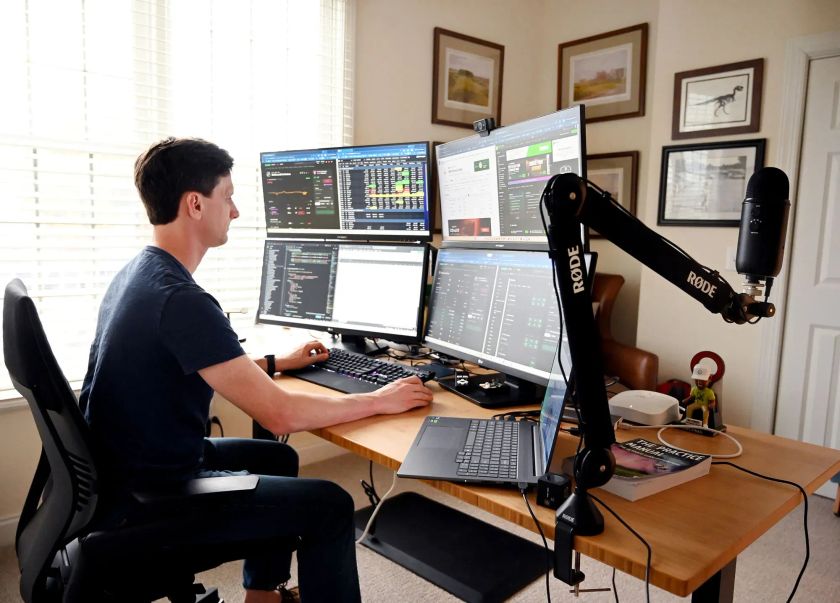
Peabody describes his strategy while sitting at his dining room table in Manhattan, where he works in front of a laptop, a pair of monitors and a phone that buzzes every few seconds. It’s a far cry from the classic vision of the bettor on the edge of his seat in a Las Vegas sportsbook, watching as games play out on walls full of flatscreens. Peabody is soft-spoken, even-keeled and not the type to get worked up about a single game. “Sharp bettors are looking for every place they can where they have an advantage,” he says. “Right now there’s a lot of alpha to be had on the prediction markets.”
One major advantage to prediction markets is that they don’t limit or exclude sharps. Exchanges pass money between winners and losers and take a small fee on each trade. It makes no difference to them if some traders win consistently. Sportsbooks, by contrast, are on the hook to pay out winners, so most take measures to identify sophisticated players and set restrictions on how much they can bet. Sharps get around these limits by building networks of surrogates who haven’t been flagged by sportsbooks. They coordinate bets in groups on the messaging app Telegram and collect profits through bank transfers or cryptocurrency transactions, or by handing over a literal “bag of cash,” according to Antonino De Rosa, a 44-year-old sharp who lives in Port Saint Lucie, Florida.
De Rosa, who’s part of a 17-person betting syndicate, works from his home office identifying promising bets and doing postmortems of the 30 or so wagers his colleagues make every day. His group focuses on tennis and the NBA, using a model it built to simulate each player or team’s odds based on factors like the latest score and who has possession. Sometimes he watches games live to make sure nothing happens that the models may have missed. (He also just likes watching sports.)
De Rosa and his colleagues put down roughly $12 million a week. Because this happens largely through surrogates, just getting the money out the door can be arduous. “For us to bet $30,000 or $40,000 on a tennis game, we have to click over 300 accounts,” De Rosa says, admitting he isn’t always able to get his money back from his surrogates. “I always say we’re sports bettors, we’re not gangsters. So we get stiffed all the time.”
Prediction markets have no such complications, but they do come with their own anxieties. When De Rosa logs in to an exchange like Kalshi, he sees a flashing order book of the prices other users are offering. At the top of the list are the best bids and offers—the highest price someone is willing to pay, or the lowest price at which someone is willing to sell. The fees also vary depending on the odds, and whether you’re a market maker or a taker. “When you go to Kalshi, first of all it looks like you need some kind of degree just to understand what’s going on,” De Rosa says.
Sometimes De Rosa operates as a taker, buying contracts at the best price he sees. But he can also act as a market maker, offering a price and setting the quantity of contracts he’s after. This is where things get more complicated, riskier and, potentially, more lucrative. Because Kalshi and other exchanges fill orders from oldest to most recent, getting to the head of the queue is the only way to get action. This means sharps have to do more than master probabilities; they have to anticipate how other traders will behave and act before other market makers do. “It’s very game theoretical,” Peabody says.
One habitual market maker is John Shilling, who runs a gambling operation called Blackbriar Technologies with two partners who were both financial traders in Chicago. Drawing on that experience, he and his partners assembled an automated trading system to place orders. The sportsbooks where Shilling used to spend his time would have quickly banned such a tool, but prediction markets allow it to operate. “When Kalshi came it changed overnight what was valuable,” Shilling says from his home office outside Charleston, South Carolina.
As they hone their new trade, Blackbriar’s operators contend with its inherent dangers. In August, their outfit was among the first makers to offer prices for each player in the upcoming PGA Tour Championship. Because the top-ranked Scottie Scheffler had won the BMW Championship the week before, bettors flocked to put down wagers on him, leaving Blackbriar exposed to steep losses if he won. “Before we could blink we were probably short more than $150,000 on Scottie,” Shilling says. In the end, Blackbriar accumulated a $329,853 position against Scheffler.
Luckily for the firm, Scheffler came up short, netting Shilling and his colleagues a $415,105 payout. But it was a reminder that market making can leave a trader with lopsided risks. Defending oneself requires constant vigilance, being ready to pull offers the minute news breaks that a star player will miss a game, or limit the amount of bets you’ll take on any single event. Like Shilling, Peabody and his team have developed software to automate much of this work, allowing them to instantly remove orders when prices change suddenly, as often happens, for instance, after the announcement of an injury.
As ever, skilled gamblers make their money by being right more often than the person on the other side, whether that is a sportsbook or, in the case of Kalshi, a fellow gambler. The good news for sharps, at least for now, is that the hype around prediction markets means there are a lot of inexperienced bettors around. Robinhood, the popular stock and cryptocurrency trading platform, and the crypto exchange Coinbase, provide their customers access to popular markets on Kalshi.
Peabody signed up for his own Robinhood account so he could monitor which markets were available to these bettors, who provide the “soft recreational flow” he needs to maximize his returns. Frequently, this means taking the side of heavy favorites against bettors who are hoping for longshot wins. Early in the men’s college basketball season, for instance, Peabody placed an order on Kalshi for 500,000 contracts, at 99¢ each, for Columbia University to lose against the University of Connecticut.
When Columbia lost (by a score of 89-62) the net profit for Peabody was just a few thousand dollars. If they’d won, he would have lost hundreds of thousands. He was willing to risk it because his model, which runs thousands of simulations of every college basketball game, told him UConn had a greater than 99% chance of winning. Peabody calls this “picking up pennies in front of a steamroller.” He can’t see who is leaving these pennies, but he assumes they’re coming from Robinhood.
Sometimes, though, the roles are reversed. That same month, Peabody noticed someone had offered to trade at a price assuming that Loyola Chicago’s men’s basketball team had a 98% chance of beating Mercyhurst, though his model showed the odds were much lower. “I was like, ‘Who’s this idiot that put up 98¢?’” he says.
Peabody bet $10,000 and ended up winning half a million dollars when Mercyhurst upset Loyola 73-65.
Sharps realize that they may not be the smartest people in the room forever. In general, markets evolve, and smart traders find their advantage narrows as other sophisticated players chase the same opportunities. This happened with electronic stock trading in the 1990s and more recently, as De Rosa recalls, with fantasy sports and online poker, when the dumb money got discouraged and started leaving. The big trading firms are already tilting the playing field.
With the increased competition, De Rosa estimates his betting group is making a profit of only about 2% on exchanges, compared with 4% or 5% on sportsbooks. Many of the sharps are keeping much of their money in sportsbooks, and where they go in the future will depend on whether prediction markets manage to lure and keep the minnows. “Eventually the casual players will lose their money, and eventually there will only be sharks left,” he says. “I want to just tell people, ‘Please be careful, because these places are infested by smart people.’”