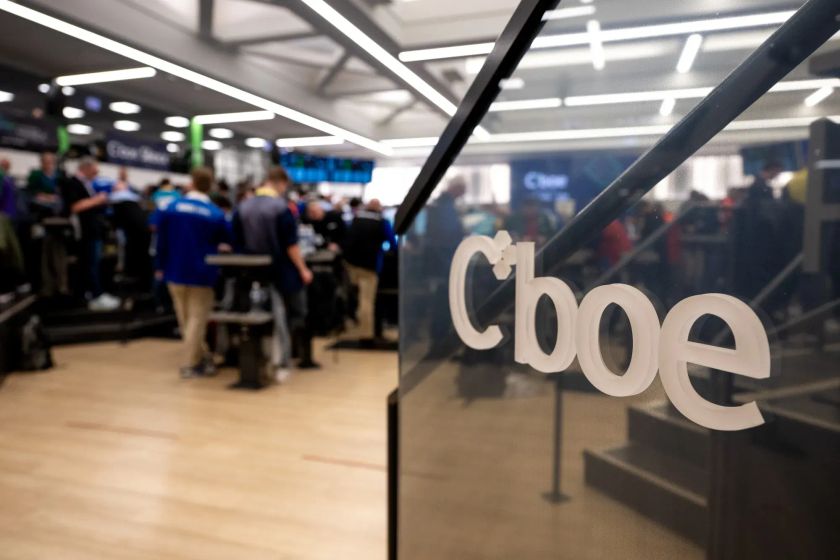
Exchange operator Cboe Global Markets Inc. plans to roll out options contracts that will enable binary bets on event outcomes, in a bid to enter the fast-growing prediction markets.
In a departure from the approach taken by rivals, Cboe’s contracts will be regulated by the Securities and Exchange Commission, requiring a more onerous listing process that could help insulate the bourse from the avalanche of litigation facing the event contract market.
Cboe wants to list the event contracts on the S&P 500 by the end of June this year, the Chicago-based company’s chief executive officer Craig Donohue told analysts on an earnings call Friday.
“It will be the all-or-none style combined with what we feel is a way to intertwine some of the spread trading that we see going on today in SPX,” Donohue said, referring the exchange’s flagship S&P 500 Index Options complex.
Cboe is a relative latecomer to prediction markets, with crosstown competitor CME Group’s joint venture with Flutter Entertainment Plc already up and running, and Polymarket and Kalshi leading the pack in terms of volumes.
Prediction exchanges like Kalshi have upended the gambling industry by listing financial contracts related to sports, politics and pop culture. They are regulated by the US futures regulator, the Commodity Futures Trading Commission, which allows new contracts to be ‘self-certified’ with minimal regulatory oversight. This has sparked allegations of misconduct, including complaints about insider trading, and legal challenges from multiple US states over alleged breaches of gaming rules.
Cboe said it plans to take a stricter approach that will bring the safeguards created around listed securities to predictions markets.
“Our first initial offerings will be securities products,” Rob Hocking, global head of derivatives at Cboe, said during the company’s fourth-quarter earnings call. “We think that’s the best way to reach the broadest set of end users and it clearly differentiates what we’re doing from a lot of the non-security based platforms already in the market.”
The move is not Cboe’s first foray into binary options. The exchange has experimented with them in the past, listing contracts on the S&P 500 and the Cboe Volatility Index in 2008. But at the time there was little appetite among traders for the derivatives and the products were quietly delisted in 2017.
Donohue said in November that the exchange operator would avoid sports contracts, and stick to offering yes or no bets on financial, corporate and economic data points.
Cboe’s adjusted Ebitda rose 40% in the fourth quarter of 2026 to $464 million, while net revenue was up 28% to $671 million.